What do you get if you combine a project manager with a commercial building surveyor?
A commercial building surveyor acting as a technical project manager brings something extra to the table: deep construction knowledge layered on top of the traditional project management skillset. For commercial property owners and occupiers in New Zealand, it's a distinction that can make a significant difference to the quality of the construction outcome.
Project management as a profession is largely built around process, scheduling, and budget tracking. These are genuinely important skills. But construction projects aren't just logistics exercises. They involve waterproofing, structural connections, building regulations, workmanship standards, and a thousand other technical variables that can go badly wrong if no one on the client's side actually understands what they're looking at.
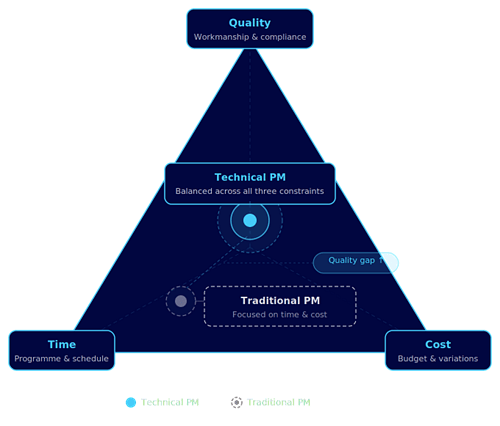
This is where the three pillars of project delivery come in: time, cost, and quality. Most project managers are strong on the first two. The third one is where a building surveyor adds something genuinely different.
The Iron Triangle and Its Missing Leg
The "iron triangle" of project management - time, cost, and quality - holds that these three things are interconnected, and you can't optimise all three simultaneously without trade-offs.
Many project managers are trained primarily in time and cost management. Quality is a different matter. It requires someone who can read a specification, walk onto a site, and say with confidence whether a waterproofed junction or steel connection has been done correctly. Quality monitoring is only meaningful if the person doing it knows what good looks like, and that takes years of getting up close with buildings that have gone wrong.
What a Commercial Building Surveyor Brings to the Table
A chartered commercial building surveyor spends their career looking at buildings in forensic detail. By the time they've reached a senior level, they've seen a lot of things go wrong. This is precisely why they can add a third dimension of quality control beyond the designers and contractors. That diagnostic mindset, applied during a project rather than after the fact, is the difference between catching a problem while the contractor is still on site and inheriting it as a defect after the practical completion certificate has been signed.
The Quality Gap in Practice
Take a commercial fitout with a specified waterproofing system on a balcony or wet area. A project manager can confirm it was installed on schedule and within budget, but was the correct product used? Were laps properly bonded, upstands at the right height, drainage outlets correctly integrated? Without someone technically trained to check, those questions don't get asked until there's a leak and the contractor's warranty has become a legal argument.
What RICS Membership Means for Clients
A RICS-chartered building surveyor operates under a strict professional code of conduct enforced by the Royal Institution of Chartered Surveyors. RICS membership requires professional indemnity insurance, mandatory CPD, and accountability to a regulatory body. This provides a layer of client protection that a general project manager without professional registration may not offer.
The Commercial Property Context
Commercial occupier fit-outs, landlord refurbishments, and dilapidations-driven reinstatement projects sit at the intersection of technical construction knowledge and property law. Understanding lease obligations, specifying reinstatements to avoid future dilapidations liability, evaluating variation claims on both contractual and technical merit - these are capabilities a commercially focused building surveyor has by default.
For commercial occupiers and investors in Auckland and across New Zealand, where construction costs are high and contractor accountability can be difficult to enforce, having a technically trained representative on your side is particularly valuable.
At Pinnacle, This Is How We Work
At Pinnacle Building Consultancy, we work exclusively in the commercial property sector. Every client works directly with both directors, and every project gets the benefit of 50 years of combined commercial building surveying experience. Our clients get time and cost management and technical oversight as a single integrated service - not a project manager who'll hand you a programme and a budget report, but someone on site, checking the work against the specification, making sure the building you end up with is the one you specified and paid for.
The Bottom Line
Time, cost, and quality. All three matter. If your project manager can only hold the contractor accountable on two of them, it's usually the quality leg that gets short-changed. A commercial building surveyor operating as a technical project manager changes that equation - from building pathology and construction methodology through to contract law and programme management, with some hard-learnt experience along the way.
If you're planning a commercial fit-out, refurbishment, or reinstatement project in New Zealand and want to talk through how a technical project management approach might benefit you, get in touch with the team at Pinnacle Building Consultancy.